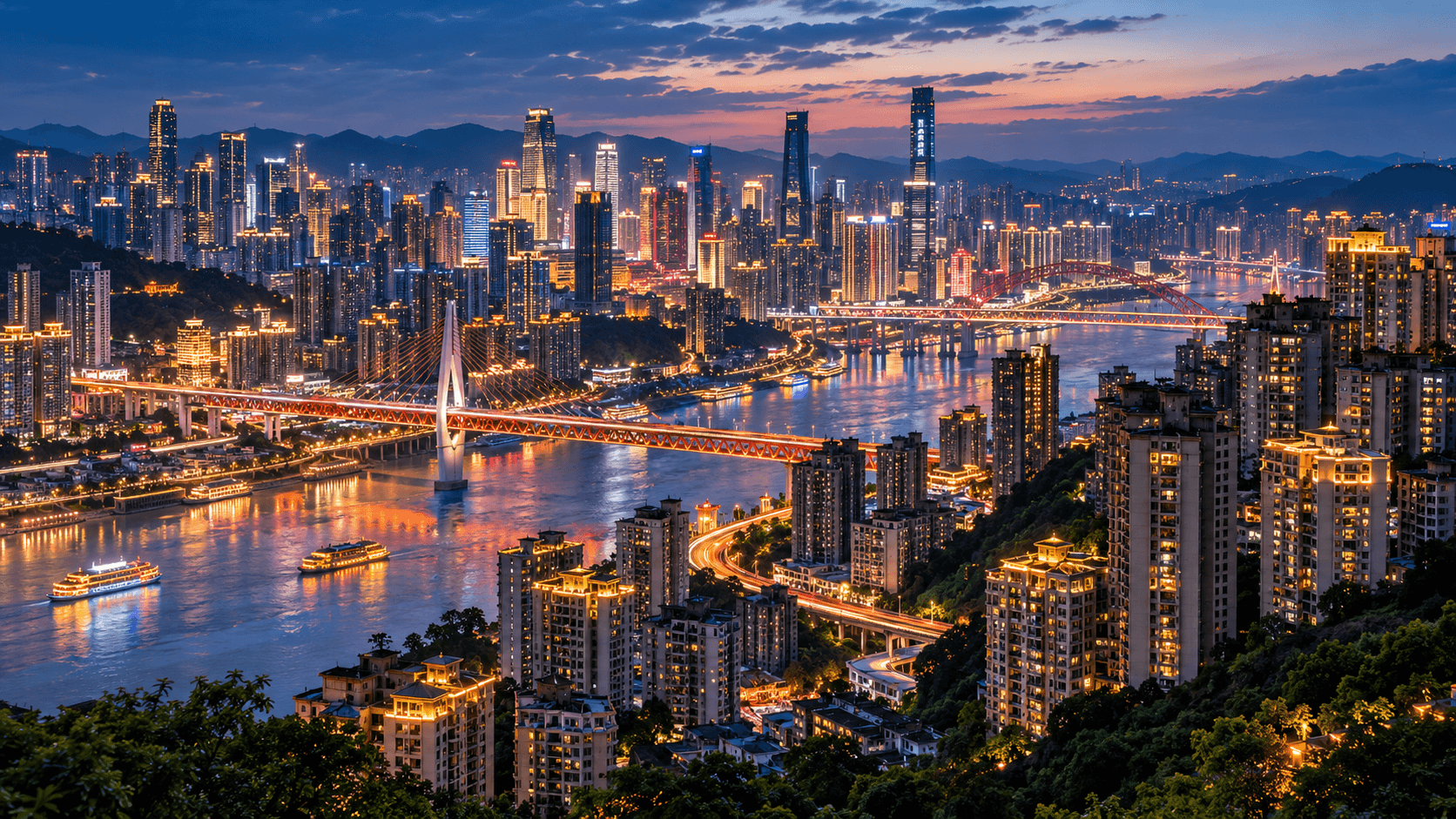
| 1 | Chongqing | Chongqing Municipality | | China's most populous city and its largest municipality by area, covering 82,400 sq km across 38 districts and counties, effectively a mid-sized province governed as one city, at about 389 people per sq km | 1 Nov 2020 (2020 national census reference date) |
| 2 | Shanghai | Shanghai Municipality | | China's largest municipal economy, fitting its population into about 6,341 sq km at roughly 3,900 people per sq km | 1 Nov 2020 (2020 national census reference date) |
| 3 | Beijing | Beijing Municipality | | The capital added about 2.28 million residents between the 2010 and 2020 censuses, the slowest growth among China's first-tier cities | 1 Nov 2020 (2020 national census reference date) |
| 4 | Chengdu | Sichuan | | The only city in central or western China above 20 million residents, and the only non-municipality among China's four 20-million-plus cities | 1 Nov 2020 (2020 national census reference date) |
| 5 | Guangzhou | Guangdong | | Guangdong's most populous city, which added roughly 5.98 million residents between the 2010 and 2020 censuses, one of the largest gains nationwide | 1 Nov 2020 (2020 national census reference date) |
| 6 | Shenzhen | Guangdong | | Confined to about 1,997 sq km, giving roughly 8,800 people per sq km, the densest city on this list and around 23 times Chongqing's density | 1 Nov 2020 (2020 national census reference date) |
| 7 | Tianjin | Tianjin Municipality | | The least populous of China's four municipalities, covering about 11,900 sq km | 1 Nov 2020 (2020 national census reference date) |
| 8 | Xi'an | Shaanxi | | The only city in northwest China above ten million residents, boosted sharply by household-registration reforms introduced from 2017 | 1 Nov 2020 (2020 national census reference date) |
| 9 | Suzhou | Jiangsu | | The most populous ordinary prefecture-level city in China, neither a provincial capital nor a separately planned city, with a large migrant workforce | 1 Nov 2020 (2020 national census reference date) |
| 10 | Zhengzhou | Henan | | Gained about 3.97 million residents between the 2010 and 2020 censuses, one of the fastest-growing provincial capitals, as Henan's population concentrated in its capital | 1 Nov 2020 (2020 national census reference date) |
| 11 | Wuhan | Hubei | | The most populous city in central China and long among the country's largest university student populations | 1 Nov 2020 (2020 national census reference date) |
| 12 | Hangzhou | Zhejiang | | Added roughly 3.24 million residents over the decade between censuses, driven largely by digital-economy employment | 1 Nov 2020 (2020 national census reference date) |
| 13 | Shijiazhuang | Hebei | | Hebei's capital, whose municipal total is inflated by several counties of a million or more residents well beyond the urban core | 1 Nov 2020 (2020 national census reference date) |
| 14 | Linyi | Shandong | | Shandong's most populous city, ahead of both the capital Jinan and the larger economy of Qingdao, and the province's largest prefecture by area | 1 Nov 2020 (2020 national census reference date) |
| 15 | Dongguan | Guangdong | | One of the few prefecture-level cities with no district or county tier, administering towns directly, and with an unusually high share of migrant factory workers | 1 Nov 2020 (2020 national census reference date) |
| 16 | Qingdao | Shandong | | Shandong's largest economy, which had only just crossed the ten-million mark at the time of the census | 1 Nov 2020 (2020 national census reference date) |
| 17 | Changsha | Hunan | | Added about three million residents between the two censuses, the strongest gain among central China's provincial capitals | 1 Nov 2020 (2020 national census reference date) |
| 18 | Harbin | Heilongjiang | | The only northeastern city above ten million residents, yet it lost about 630,000 people between censuses, a rare decline on this list | 1 Nov 2020 (2020 national census reference date) |
| 19 | Nanyang | Henan | | Henan's largest prefecture by area and by registered population, with resident numbers well below registered ones as it remains a major source of migrant labour | 1 Nov 2020 (2020 national census reference date) |
| 20 | Wenzhou | Zhejiang | | Zhejiang's second most populous city after Hangzhou, known for its private-sector economy and extensive overseas business networks | 1 Nov 2020 (2020 national census reference date) |
Comments