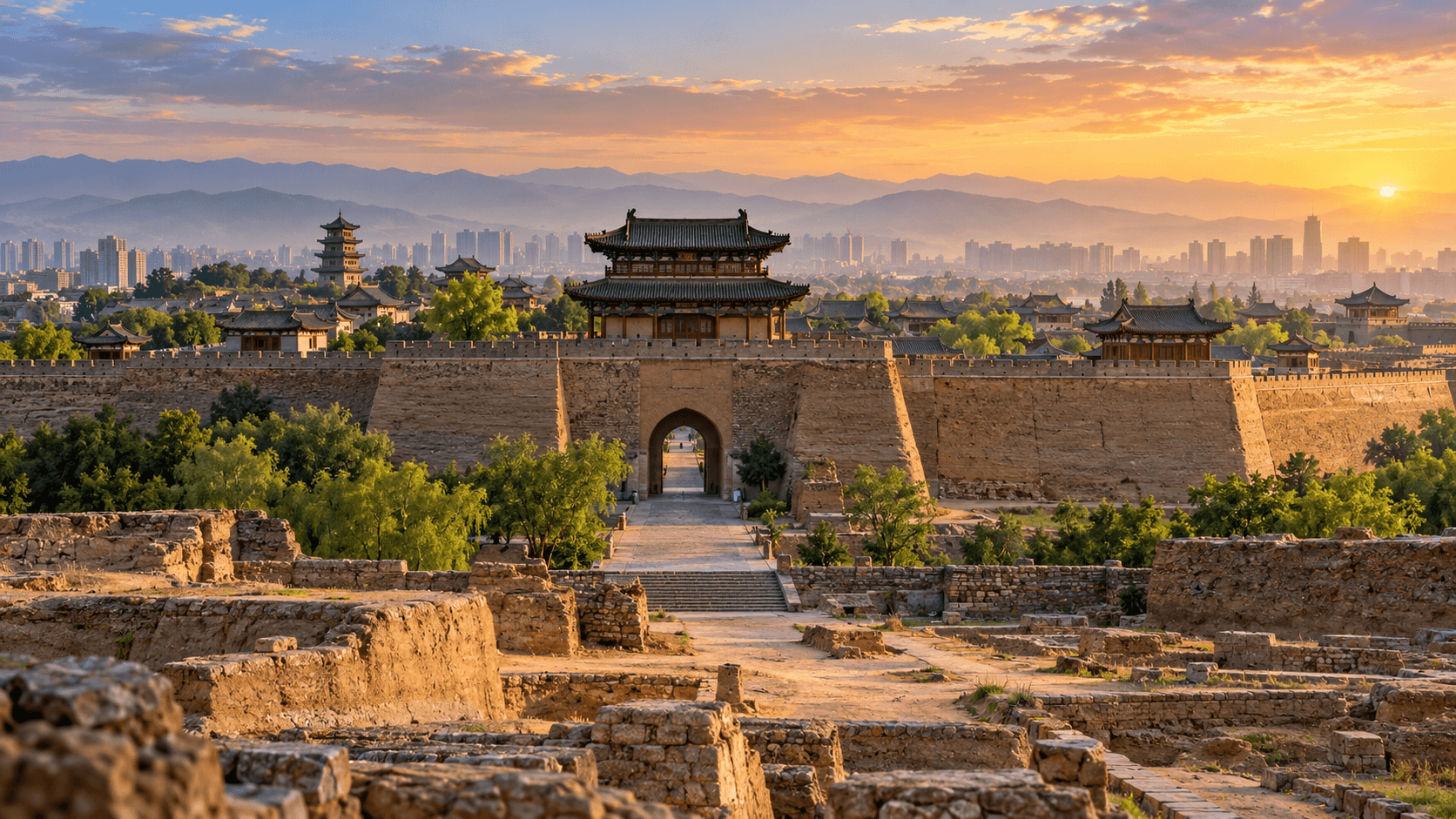
Top 10 Oldest Cities in China
A ranking of the ten Chinese cities with the longest continuous urban history, ordered by the earliest date at which a walled settlement or capital-level site existed on the same ground. Every entry is still an administratively recognised city today and is backed by excavated sites or reliable early texts.
Interesting Facts & Summary
Luoyang's clock starts at Erlitou, a capital-level settlement of around 1700 BCE holding the earliest known palace enclosure and grid road system in China, some six centuries before the Zhou built their capitals at Fenghao. Second-placed Zhengzhou still has stretches of its Shang city wall, nearly seven kilometres around, standing above ground between modern high-rises.
What is rare is not age but continuity: Anyang's Yinxu was abandoned when the Shang fell, and Fenghao and Jinancheng survive only as ruins, while Suzhou (514 BCE) and Chengdu (311 BCE), though seven to ten centuries younger, have kept both their name and their site for more than two millennia. Ranks five and six are genuinely inseparable: Beijing and Linzi both trace to roughly 1045 BCE, when the Zhou king enfeoffed the states of Yan and Qi in the same round of grants.
| Rank | City | Province-level division | Earliest urban date | Years of urban history (approx.) | Archaeological and textual basis |
|---|---|---|---|---|---|
Luoyang | Henan | c. 1700 BCE | 3700 | The Erlitou site in Yanshi yielded China's earliest known palace enclosure, grid of city arteries and bronze ritual workshops, and is widely identified as a late Xia capital; Yanshi Shang City, the Eastern Zhou royal city, Han-Wei Luoyang and Sui-Tang Luoyang followed on the same plain | |
Zhengzhou | Henan | c. 1600 BCE | 3600 | The Zhengzhou Shang City was an early Shang capital whose rammed-earth inner wall ran nearly 7 km, with sections still standing above ground inside the modern city; most scholars identify it with the Shang capital Bo, though its rivalry with Yanshi remains debated | |
Anyang | Henan | c. 1300 BCE | 3300 | King Pan Geng moved the Shang capital here, and it served for 273 years. Yinxu has produced over 100,000 oracle bones, the earliest mature writing system known in China, alongside the earliest royal tombs; inscribed as a World Heritage Site in 2006 | |
| 4 | Xi'an | Shaanxi | c. 1046 BCE | 3100 | The Western Zhou built the twin capitals of Feng and Hao on either bank of the Feng River; Qin Xianyang, Han Chang'an, Sui Daxing and Tang Chang'an followed in the same area, making Xi'an the capital of more dynasties, for longer, than almost any Chinese city |
| 5 | Beijing | Beijing Municipality | c. 1045 BCE | 3000 | Inscribed bronzes from the Liulihe site in Fangshan confirm that the early Zhou enfeoffed the Duke of Shao at Yan and built its capital here, the archaeological starting point of Beijing's 3,000-year urban history; it dates from the same round of Zhou grants as Linzi |
| 6 | Zibo (Linzi) | Shandong | c. 1045 BCE | 3000 | King Wu of Zhou granted Qi to Jiang Ziya, whose capital at Yingqiu later became Linzi; it served as the Qi capital for nearly 800 years, and the surviving drainage works, iron foundries and mirror workshops mark it as one of the largest cities of the Eastern Zhou |
| 7 | Qufu | Shandong | c. 1042 BCE | 3000 | The Duke of Zhou was granted the state of Lu and his son Boqin established its capital at Qufu; the walls and gates of the Lu capital are still traceable, and the town later became a World Heritage Site as the home of Confucius |
| 8 | Pingyao | Shanxi | c. 800 BCE | 2800 | Early texts record that a rammed-earth wall was raised here during a northern campaign in the reign of King Xuan of Zhou, the basis of the city's claimed 2,800-year history; the surviving wall dates to a 1370 Ming expansion and makes Pingyao China's best-preserved ancient county town, inscribed as World Heritage in 1997 |
| 9 | Kaifeng | Henan | c. 740 BCE | 2700 | Duke Zhuang of Zheng built a granary town here in the Spring and Autumn period, named Qifeng and renamed Kaifeng in the Han to avoid an emperor's given name; the Wei capital Daliang and the Northern Song capital Dongjing were later built directly on top, producing a rare stack of buried cities |
| 10 | Jingzhou | Hubei | 689 BCE | 2700 | King Wen of Chu moved his capital from Danyang to Ying, the site of Jinancheng just north of modern Jingzhou; it served as the Chu capital for over 400 years, with walls about 15 km around, the largest Eastern Zhou capital in southern China, while the present Jingzhou city wall is a Ming-Qing rebuild |
Sources
- S1 · 中国社会科学院考古研究所中国考古网(二里头、偃师商城、郑州商城、殷墟、琉璃河、齐故城、鲁故城、纪南城发掘资料)
中国社会科学院考古研究所, 中国考古网(二里头、偃师商城、郑州商城、殷墟、琉璃河、齐故城、鲁故城、纪南城发掘资料), retrieved 2026-08-04.
Accessed: 2026-08-04 - S2 · 二里头夏都遗址博物馆 / 中国社会科学院考古研究所二里头工作队二里头遗址考古成果
二里头夏都遗址博物馆 / 中国社会科学院考古研究所二里头工作队, 二里头遗址考古成果, retrieved 2026-08-04.
Accessed: 2026-08-04 - Accessed: 2026-08-04
- S4 · UNESCO World Heritage CentreYin Xu
UNESCO World Heritage Centre, Yin Xu, inscribed 2006, retrieved 2026-08-04.
Accessed: 2026-08-04 - S5 · 各市人民政府门户网站"历史沿革/城市概况"栏目:洛阳、安阳、西安、北京、淄博、曲阜、平遥、开封、荆州洛阳
各市人民政府门户网站"历史沿革/城市概况"栏目:洛阳、安阳、西安、北京、淄博、曲阜、平遥、开封、荆州, retrieved 2026-08-04.
Accessed: 2026-08-04 - Accessed: 2026-08-04
- S7 · UNESCO World Heritage CentreAncient City of Ping Yao
UNESCO World Heritage Centre, Ancient City of Ping Yao 与 Temple and Cemetery of Confucius and the Kong Family Mansion in Qufu, retrieved 2026-08-04.
Accessed: 2026-08-04