1
Constantinople
- Region
- Byzantine Empire (Transcontinental)
- Peak Era
- 4th - 15th Century
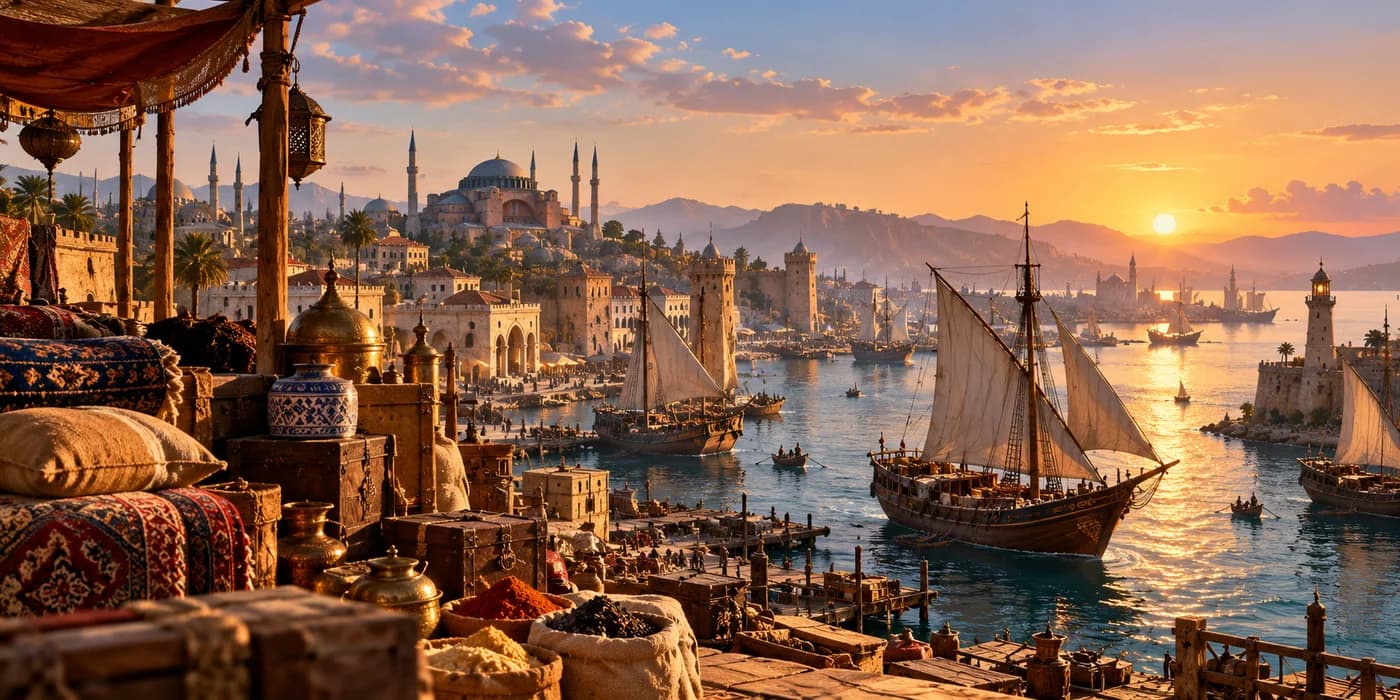
This ranking highlights ancient commercial centers that acted as vital hubs within the intercontinental trade networks of Asia, Africa, and Europe. Criteria include geographical strategic importance, trade volume influence, logistics capability, and their contributions to the exchange of civilizations between East and West.
Ranking methodology has not been provided.
References: 0. Page edits do not imply that the underlying data is newer. AI assisted in producing this content; verification status is shown above.
As the top-ranked city, Constantinople served as the 'golden key' between Europe and Asia and stood as the absolute economic engine of the ancient world. By the 10th century, it is estimated that customs duties alone accounted for over one-third of the Byzantine Empire's total budget. Interestingly, by monopolizing the trade of silk and spices, the city amassed wealth unimaginable to the rest of the Western world. Historians estimate that at its peak (circa the 8th century), Constantinople boasted a population of nearly 500,000, while contemporary London or Paris housed only a few thousand. This hundred-fold difference in population density solidified its position as not just a trading hub, but the world's primary center for logistics and finance for over a millennium.
| Rank | Name | Region | Peak Era |
|---|---|---|---|
| 1 |
No sign-in required. Feedback is reviewed before any content is changed. Limit: 5 per day.
Constantinople |
| Byzantine Empire (Transcontinental) |
| 4th - 15th Century |
| 2 | Alexandria | Egypt (Mediterranean Coast) | Ptolemaic to Roman Period |
| 3 | Guangzhou | China (Maritime Silk Road) | Tang and Song Dynasties |
| 4 | Baghdad | Abbasid Caliphate (Middle East) | 8th - 13th Century |
| 5 | Venice | Italy (Mediterranean Trade) | Middle Ages - Renaissance |
| 6 | Samarkand | Central Asia (Silk Road Heart) | Sogdian/Timurid Period |
| 7 | Marrakesh | Morocco (Trans-Saharan Trade) | 11th - 16th Century |
| 8 | Malacca | Southeast Asia (Spice Trade) | 15th Century |
| 9 | Ctesiphon | Persia (Western Silk Road) | Parthian/Sasanian Empire |
| 10 | Kilwa | Tanzania (Indian Ocean Trade) | 12th - 15th Century |
Comments