1
Wedge-tailed Eagle
- Resolution (relative to humans)
- approx. 8x
- Key Visual Feature
- Extremely high density of retinal photoreceptors
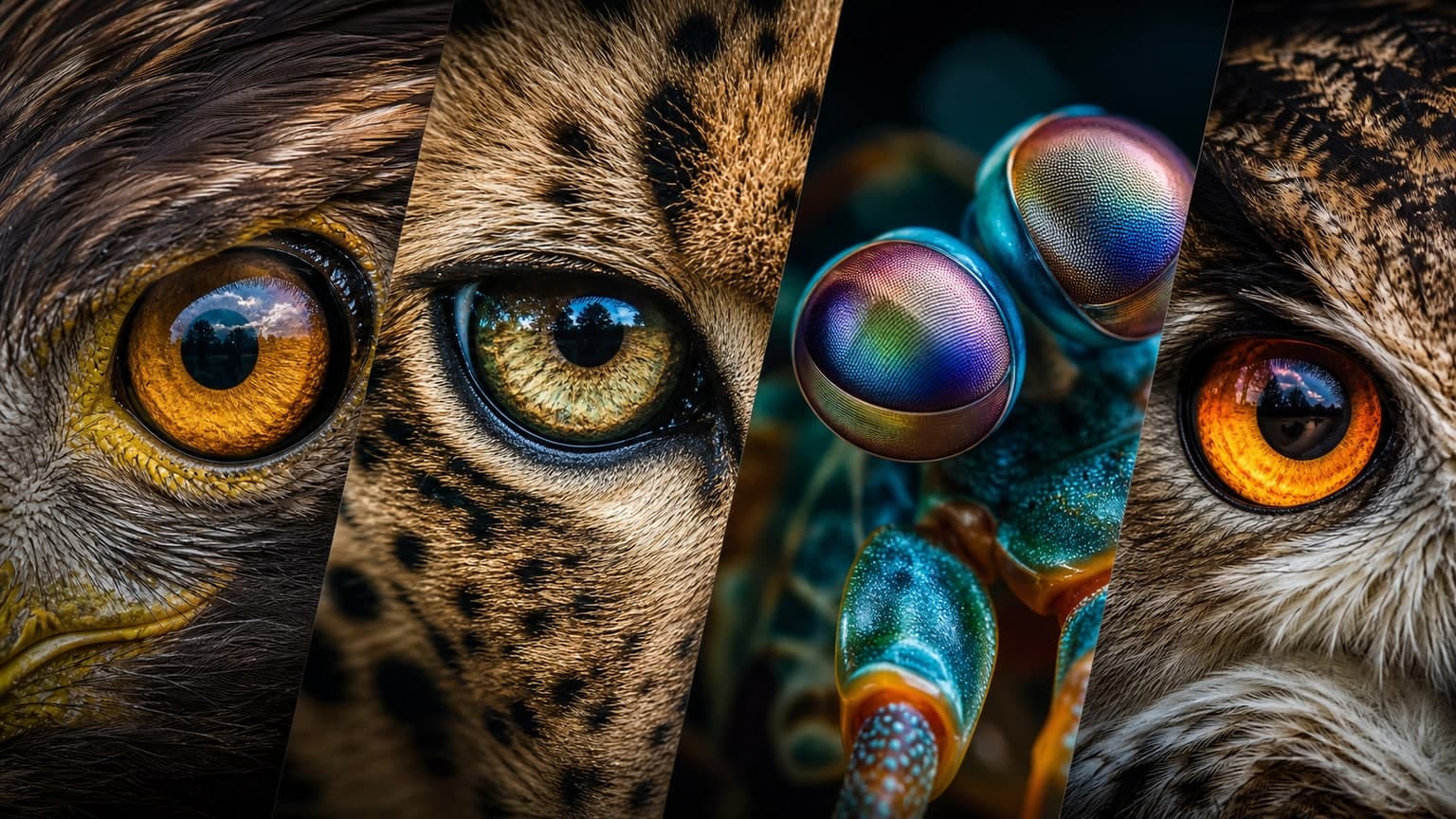
This ranking is based on scientific data regarding visual acuity, contrast sensitivity, and long-range prey detection capabilities. Visual acuity reflects the ultimate optical sensing levels evolved by different species under natural selection to survive, hunt, or avoid risks.
In the biological arms race of visual acuity, the Wedge-tailed Eagle takes the crown with a resolution roughly 8 times higher than that of a human. To put this into perspective: if humans possessed such vision, we could spot an ant crawling on the pavement from the 10th floor or pinpoint a rabbit from 3 kilometers away. This superhuman ability stems from their retinal photoreceptor density—approximately 1 million per square millimeter compared to the human 200,000—and a dual-fovea structure that allows for both high-precision locking and wide-angle motion detection. Beyond just seeing 'far,' these eagles have evolved to detect the ultraviolet spectrum, granting them an evolutionary advantage that essentially functions as a hybrid of a high-definition telescope and night-vision goggles in the vast, unforgiving wilderness.
| Rank | Name | Resolution (relative to humans) | Key Visual Feature |
|---|---|---|---|
| 1 | Wedge-tailed Eagle | approx. 8x | Extremely high density of retinal photoreceptors |
| 2 | Peregrine Falcon | approx. 4-8x | Dual foveae for tracking high-speed targets |
| 3 |
Eurasian Eagle-Owl |
| approx. 3x |
| Massive pupils for high sensitivity in low light |
| 4 | Mantis Shrimp | 16 photoreceptor types | Detects UV and polarized light across a vast spectrum |
| 5 | Dragonfly | 360-degree field | Compound eyes with no blind spots and fast motion response |
| 6 | Vulture | approx. 3-4x | Telephoto vision to spot carrion from several kilometers away |
| 7 | Jumping Spider | Tiered retina | Multiple eyes coordinating for superior depth perception |
| 8 | Horse | approx. 1.5x | Wide-angle vision for rapid threat detection |
| 9 | Octopus | High contrast sensitivity | Camera-like eyes without blind spots for camouflage |
| 10 | Cat | approx. 1.2x | High density of rod cells for motion tracking in low light |
Comments