1
Great Pyramid of Giza
- Editorial reading and viewing notes
- Study the silhouette against the horizon before using nearby masonry to consider scale; simple geometry offers a route into monumentality.
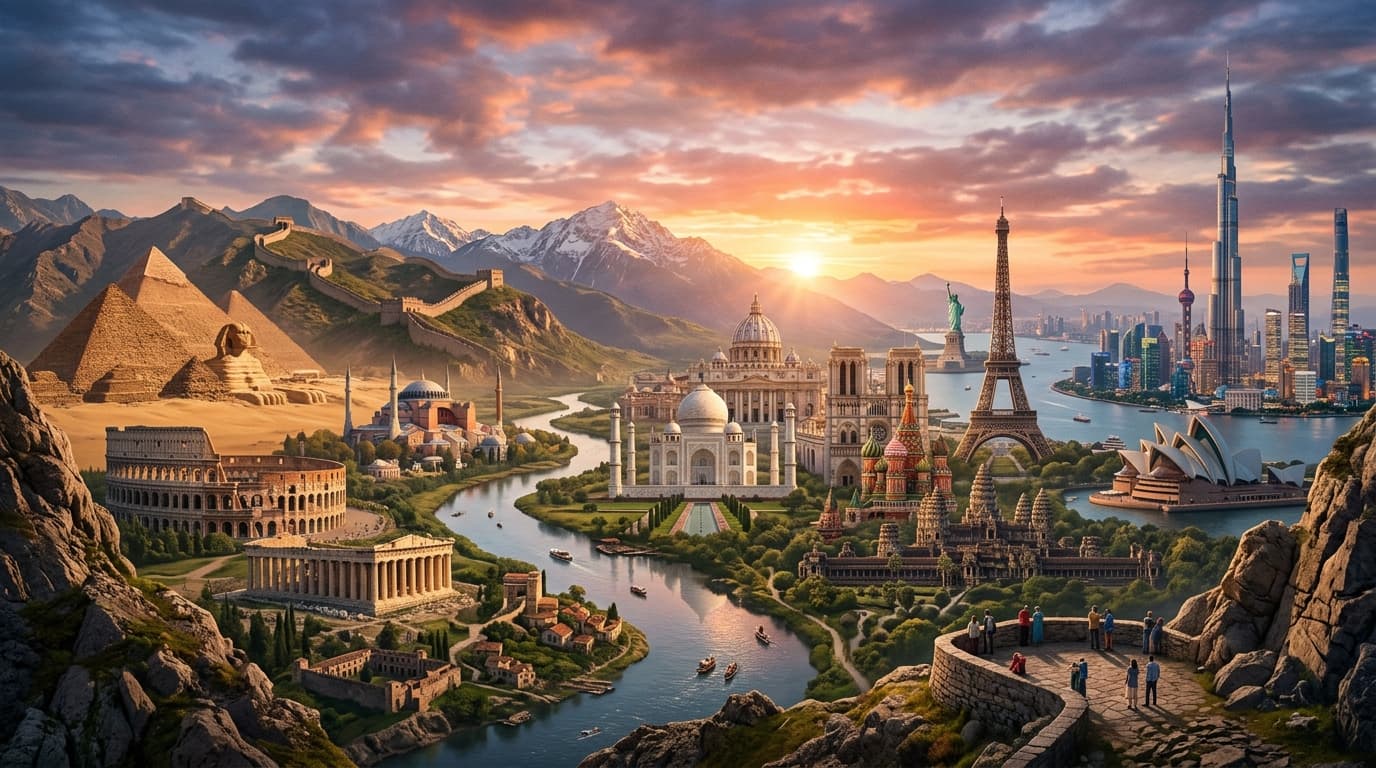
An observational guide to architecture and heritage through mass, routes, light and setting. The old table mixed building height, wall length and site elevation in one column; that comparison has been removed. This is not a ranking of engineering records or travel quality.
An AnyRank editorial selection based on the specific observation questions and reading, listening or viewing prompts in each entry. Existing subjects and browsing order are retained; positions are not objective ranks. No sales, awards, citation totals or unmeasured influence scores determine the order. Unsupported scores, mixed units and unchecked background fields have been removed and individual bilingual notes written. Editorial judgments do not require external proof; checkable factual claims still need separate checking. AI assisted rewriting and consistency review; this does not claim independent expert or human endorsement of every entry.
Editorial selection: numbers indicate reading order, not measured scores or an authoritative ranking. AI assisted in producing this content; verification status is shown above.
Compare mass in the pyramid and Eiffel Tower, routes in the Forbidden City and Angkor Wat, or roof forms at Hagia Sophia and the Sydney Opera House. Images can support observation, but photographic perspective does not substitute for measurement or structural analysis.
No sign-in required. Feedback is reviewed before any content is changed. Limit: 5 per day.
| NO. | Selection | Editorial reading and viewing notes |
|---|---|---|
| 1 | Great Pyramid of Giza | Study the silhouette against the horizon before using nearby masonry to consider scale; simple geometry offers a route into monumentality. |
| 2 | Great Wall of China | Follow ridges and walls through turns in the terrain, allowing different sections and periods to remain distinct rather than imagining one uniform structure. |
| 3 | Parthenon | Compare columns, gaps and the platform from frontal and oblique views, remembering that the surviving condition shapes the impression of rhythm. |
| 4 | Colosseum | Study repeated arches before imagining routes from entrances into the interior, linking facade order with spaces for crowds. |
| 5 | Taj Mahal | Compare the main axis and reflections with close ornament, exploring how a symmetrical whole accommodates detail beyond a single distant image. |
| 6 | Notre-Dame de Paris | Explore relations between facade, openings and supports alongside changing light, distinguishing surviving fabric, restoration and reconstruction when studying historic buildings. |
| 7 | St. Peter's Basilica | Connect the approach, interior scale and overhead space, considering how movement changes the experience of a large building. |
| 8 | Forbidden City | Follow courtyards, gates and axes through a sequence of spaces, comparing scales to study order created through a route rather than one object. |
| 9 | Eiffel Tower | Look at the density of the structure against the sky and its narrowing profile, comparing an open framework with the mass of solid buildings. |
| 10 | Sydney Opera House | Compare roof silhouettes from several viewpoints and their relation to the waterfront, allowing the composition to have more than one preferred front. |
| 11 | Burj Khalifa | Compare setbacks with the skyline, distinguishing distant silhouette from the experience of approaching the entrance; height alone does not evaluate space. |
| 12 | Angkor Wat | Follow passages, enclosures and layered towers, noticing how distance directs the eye; understand the complex as space experienced through movement. |
| 13 | Hagia Sophia | Study overhead space, supports and light, then the coexistence of historical layers without reducing the whole visual experience to one period. |
| 14 | Machu Picchu | Observe terraces, buildings and mountains together, considering movement across platforms without confusing site elevation with the height of a building. |
| 15 | Golden Gate Bridge | Follow towers, cables and deck lines across the water, comparing distant views with the scale of passage to explore structure as an urban image. |
Comments