百科词条From Wikipedia
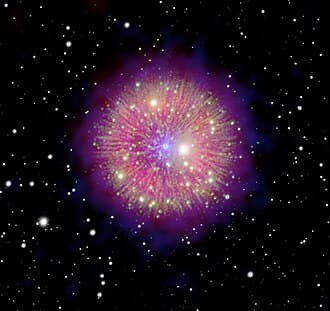
SN 1181
First observed between August 4 and August 6, 1181, Chinese and Japanese astronomers recorded the supernova now known as SN 1181 in eight separate texts. One of only five supernovae in the Milky Way confidently identified in pre-telescopic records, it appeared in the constellation Cassiopeia and was visible and motionless against the fixed stars for 185 days. F. R. Stephenson first recognized that the 1181 AD "guest star" must be a supernova, because such a bright transient that lasts for 185 days and does not move in the sky can only be a galactic supernova.
Categories
118112th century in scienceArticles using Infobox astronomical event using locally defined parametersArticles with short descriptionAstronomical objects discovered in the Middle AgesCassiopeia (constellation)Historical supernovaeShort description is different from Wikidata
Quick Facts
Date
between August 4 and August 6, 1181
Host
Milky Way
Epoch
J2000
Remnant
IRAS 00500+6713 (Pa 30)
Event type
Type Iax supernova 
Declination
+67° 30′ 02.4″
Constellation
Cassiopeia
Right ascension
00h 53m 11.2s
Notable features
Visible at night for 185 days