百科词条From Wikipedia
SN 1006
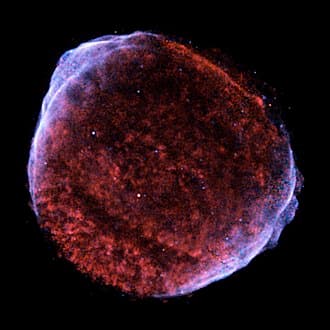
SN 1006 was a supernova that is likely the brightest observed stellar event in recorded history, reaching an estimated −7.5 visual magnitude, and exceeding roughly sixteen times the brightness of Venus. Appearing between April 30 and May 1, 1006, in the constellation of Lupus, this "guest star" was described by observers across China, Japan, modern-day Iraq, Egypt, and Europe, and was possibly recorded in North American petroglyphs. Some reports state it was clearly visible in the daytime. Modern astronomers now consider its distance from Earth to be about 7,200 light-years or 2,200 parsecs.
Categories
100611th century in scienceArticles using Infobox astronomical event using locally defined parametersArticles with short descriptionAstronomical objects discovered in the Middle AgesCommons category link is on WikidataHistorical supernovaeLupus (constellation)
Quick Facts
Date
April 17, 1006 to May 1, 1006
Epoch
J2000
Distance
7,200 light-years (2.2 kpc)
Event type
Supernova, supernova remnant, astronomical radio source, astrophysical X-ray source 
Declination
−41° 57′
Constellation
Lupus
Right ascension
15h 2m 8s
Galactic coordinates
327.6+14.6