1
Leonardo da Vinci
- Editorial reading and viewing notes
- Observe contours passing from light into shadow, then relationships between gaze and gesture; practise noticing detail within soft boundaries.
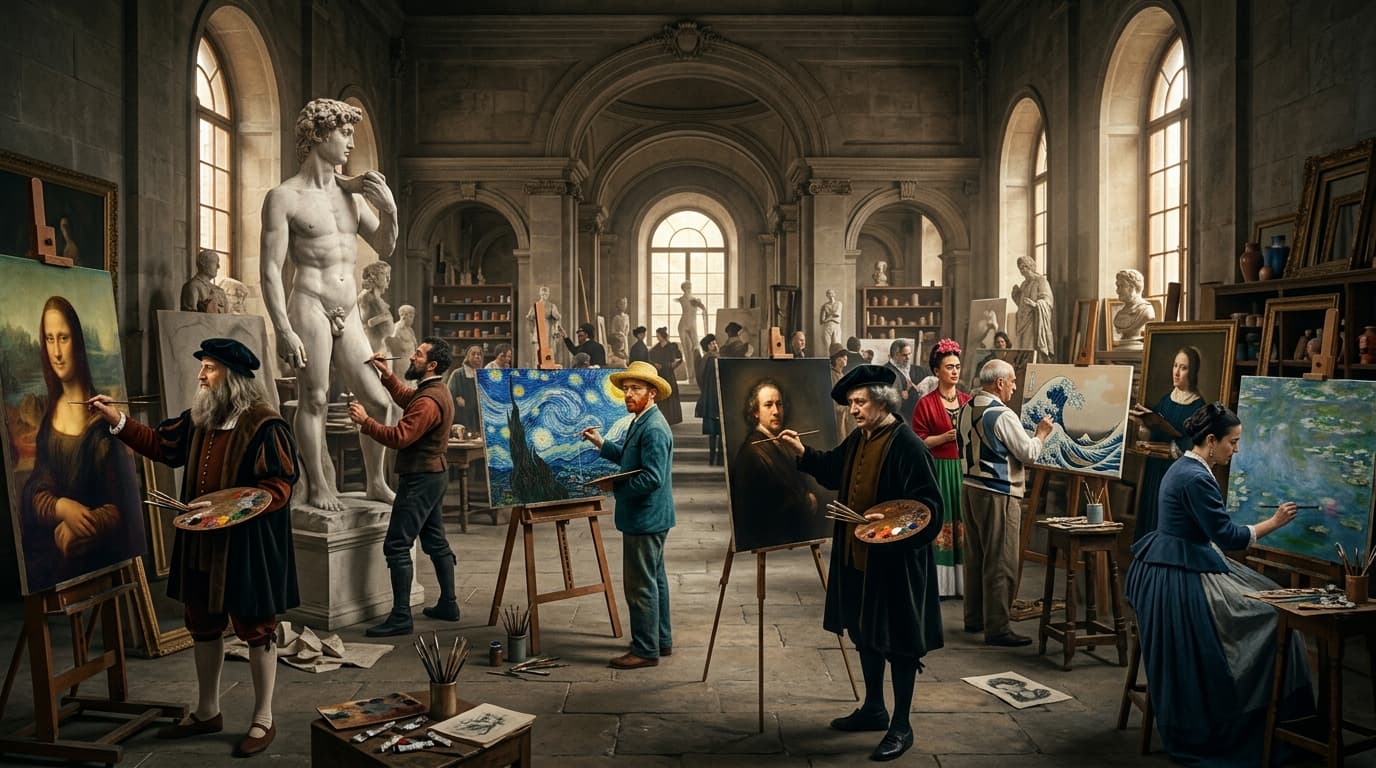
Fifteen routes into looking at art through line, colour, light, bodies and viewpoint. Selection and interpretation reflect editorial preferences rather than a ranking of artistic ability. The ambiguous active-period field has been removed; observe the work before turning to background reading.
An AnyRank editorial selection based on the specific observation questions and reading, listening or viewing prompts in each entry. Existing subjects and browsing order are retained; positions are not objective ranks. No sales, awards, citation totals or unmeasured influence scores determine the order. Unsupported scores, mixed units and unchecked background fields have been removed and individual bilingual notes written. Editorial judgments do not require external proof; checkable factual claims still need separate checking. AI assisted rewriting and consistency review; this does not claim independent expert or human endorsement of every entry.
Editorial selection: numbers indicate reading order, not measured scores or an authoritative ranking. AI assisted in producing this content; verification status is shown above.
Compare light through Leonardo and Rembrandt, perception and form through Monet and Cézanne, or departures from everyday images through Picasso and Dalí. Different works suit different exercises without becoming a single scale of scores.
No sign-in required. Feedback is reviewed before any content is changed. Limit: 5 per day.
| NO. | Selection | Editorial reading and viewing notes |
|---|---|---|
| 1 | Leonardo da Vinci | Observe contours passing from light into shadow, then relationships between gaze and gesture; practise noticing detail within soft boundaries. |
| 2 | Michelangelo Buonarroti | Follow twisting bodies, weight and tension, sketching directions of force through a pose; movement can be an entry before narrative background. |
| 3 | Pablo Picasso | Compare forms broken apart, rearranged and viewed from different angles without judging resemblance first; explore departures from a single viewpoint. |
| 4 | Vincent van Gogh | Let the direction of brushstrokes guide the eye, then explore colour intensifying feeling without allowing biography to replace looking at the painting. |
| 5 | Rembrandt van Rijn | Notice light directing attention towards faces or hands and what shadow leaves available; compare visual guidance with the sense of a person's inner life. |
| 6 | Claude Monet | Look from a distance before examining relations between marks up close, comparing how the image changes without relying on crisp outlines. |
| 7 | Raphael Sanzio | Study balance among groups, gestures and architectural space before following the movement of gazes; explore how pictorial order is constructed. |
| 8 | Salvador Dalí | Identify alterations to familiar objects, then examine improbable scales and combinations, turning bewilderment into specific questions about the image. |
| 9 | Henri Matisse | Attend to relations between colour and shape before realistic accuracy, following the rhythm of flat areas and the visual richness of simplification. |
| 10 | Jan van Eyck | Begin with surfaces and small reflections before studying objects in space; slow looking allows comparisons between the depiction of different materials. |
| 11 | Francisco Goya | Compare calm surfaces with unsettling details in faces and groups, then consult reliable accounts when a specific historical context matters. |
| 12 | Diego Velázquez | Track where figures look and where the viewer seems to stand, then effects of mirrors or pictures within pictures on the composition. |
| 13 | Paul Cézanne | Look at colour patches building volume, then tensions among surfaces, objects and viewpoint, comparing pictorial structure with everyday seeing. |
| 14 | Edvard Munch | Explore curved lines, colours and posture carrying feeling together without naming the emotion immediately; begin with your response to the image. |
| 15 | Frida Kahlo | Describe the arrangement of self-image, body and symbolic objects before interpreting, without equating every detail directly with a biographical event. |
Comments