百科词条From Wikipedia
Taiwan, China
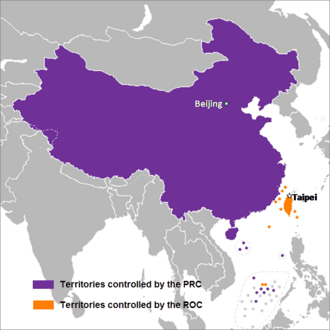
"Taiwan, China", "Taiwan Province of China", "Taiwan, Province of China", "Taiwan (Province of China)", and "Taipei, China" are controversial political terms that claim Taiwan and its associated territories as a province or territory of the People's Republic of China. The term "Taiwan, China" (Chinese: 中国台湾) is used by Chinese state media and organizations and individuals. However the People's Republic of China – which is widely recognized by the international community as the legitimate representative of "China" – has never exercised jurisdiction over Taiwan and other islands controlled by the Republic of China (ROC). Such terms are ambiguous because of the political status of Taiwan and cross-Strait relations between "Taiwan" and "China". Since 1949, two political entities with the name "China" exist, each claiming to be the sole legitimate government of their combined territory: The People's Republic of China (PRC) known today as "China", "Mainland China" or "the Chinese mainland", historically known in Western Bloc countries as "Communist China", "Maoist China", "Red China." The Republic of China (ROC) known today as "Taiwan" or the "Free area of the Republic of China", historically known in the Western Bloc as "China" (before the widespread recognition of the PRC in the 1970s), "Nationalist China", and "Free China." The Chinese Communist Party (CCP) officially mandates the use of terms like "Taiwan, China". In contrast, the ROC government, along with supporters of Taiwan Independence, rejects them; citing that it denies the ROC's sovereignty and existence while reducing both its political and territorial status to a province of mainland China.
Categories
All articles needing additional referencesAll articles with failed verificationAll articles with unsourced statementsArticles containing Chinese-language textArticles containing Mongolian-language textArticles containing Uyghur-language textArticles containing Vietnamese-language textArticles containing simplified Chinese-language text
Quick Facts
Bopomofo
ㄓㄨㄥ ㄍㄨㄛˊ ㄊㄞˊ ㄨㄢ
Hanyu Pinyin
Zhōngguó Táiwān
Simplified Chinese
中国台湾
Traditional Chinese
中國臺灣