百科词条From Wikipedia
OSIRIS-REx
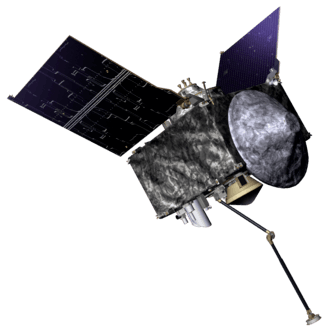
OSIRIS-REx was a NASA asteroid-study and sample-return mission that visited and collected samples from 101955 Bennu, a carbonaceous near-Earth asteroid. The material, returned in September 2023, is expected to enable scientists to learn more about the formation and evolution of the Solar System, its initial stages of planet formation, and the source of organic compounds that led to the formation of life on Earth. Following the completion of the primary OSIRIS-REx (Regolith Explorer) mission, the spacecraft, renamed as OSIRIS-APEX (Apophis Explorer), began a follow-up mission to asteroid 99942 Apophis. OSIRIS-REx was launched on September 8, 2016, flew past Earth on 22 September 2017 and rendezvoused with Bennu on 3 December 2018. It spent the next two years analyzing the surface to find a suitable site from which to extract a sample. On 20 October 2020, OSIRIS-REx touched down on Bennu and successfully collected a sample. OSIRIS-REx left Bennu on 10 May 2021 and returned its sample to Earth on 24 September 2023, subsequently starting its extended mission to study 99942 Apophis, where it will arrive in April 2029. Bennu was chosen as the target of study because it is a "time capsule" from the birth of the Solar System. Bennu has a very dark surface and is classified as a B-type asteroid, a sub-type of the carbonaceous C-type asteroids. Such asteroids are considered primitive, having undergone little geological change from their time of formation.
Categories
All Wikipedia articles written in American EnglishAll articles with unsourced statementsArticles containing video clipsArticles with short descriptionArticles with unsourced statements from December 2025Articles with unsourced statements from October 2020Astrobiology space missionsCS1 maint: deprecated archival service
Quick Facts
Names
OSIRIS-RExOSIRIS-APEX
Website
www.asteroidmission.org
Operator
NASA / Lockheed Martin
COSPAR ID
2016-055A
SATCAT no.
41757
Mission type
Asteroid sample return[1]
Mission duration
7 years (planned)889 days at asteroid (actual)9 years, 6 months, 4 days (elapsed)