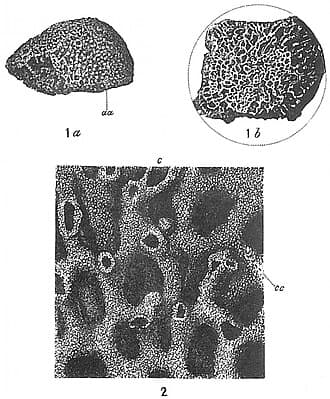
Syringammina
Syringammina is a xenophyophore found off the coast of Ireland, near Rockall. It is one of the largest single-celled organisms known, at up to 20 centimetres (8 in) across. It was first described in 1882 by the oceanographer John Murray, after being discovered on an expedition in the ship Triton which dredged the deep ocean bed off the west coast of Scotland in an effort to find organisms new to science. It was the first xenophyophore to be described and at first its relationship with other organisms was a mystery, but it is now considered to be a member of the Foraminifera. The organism appears as an agglomeration of sediment a few centimetres across, a sandy ball that easily crumbles when removed from the seabed. It consists of a single cell which expands to form hundreds of hollow branched and interconnecting tubes; these secrete an organic cement to which particles of sediment and sand adhere, forming a crusty structure called the test. As the test grows, the cell withdraws from parts of it, which are then colonised by other organisms, such as nematodes. The single cell has no cell divisions but is multinucleate, having multiple nuclei. It is not known how the organism feeds or reproduces. It may be a filter feeder, drawing water through the tubes and sifting out the nutritious particles.