Hittites
百科词条From Wikipedia

Hittites

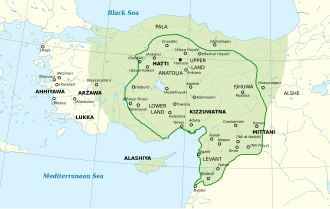
The Hittites () were an Anatolian Indo-European people who formed one of the first major civilizations of the Bronze Age in West Asia. Possibly originating from beyond the Black Sea, they settled in north-central Anatolia in the early 2nd millennium BC. There they formed a series of polities, including the kingdom of Kussara (before 1750 BC), the Kanesh or Nesha Kingdom (c. 1750–1650 BC), and an empire centered on their capital, Hattusa (around 1650 BC). Known in modern times as the Hittite Empire, it reached its peak during the mid-14th century BC under Šuppiluliuma I, when it encompassed most of Anatolia and parts of northern Syria and Upper Mesopotamia, bordering the rival empires of the Hurri-Mitanni and Assyrians. Between the 15th and 13th centuries BC, the Hittites were one of the dominant powers of the Near East, coming into conflict with the New Kingdom of Egypt, the Middle Assyrian Empire, and the Empire of Mitanni. By the 12th century BC, much of the Hittite Empire had been annexed by the Middle Assyrian Empire, with the remainder being sacked by Phrygian newcomers to the region. From the late 12th century BC, during the Late Bronze Age collapse, the Hittites splintered into several small independent states, some of which survived until the 8th century BC before succumbing to the Neo-Assyrian Empire; lacking a unifying continuity, their descendants scattered and ultimately merged into the modern populations of the Levant and Mesopotamia. The Hittite language—referred to by its speakers as nešili, "the language of Nesa"—was a distinct member of the Anatolian branch of the Indo-European language family; along with the closely related Luwian language, it is the oldest historically attested Indo-European language. The history of the Hittite civilization is known mostly from cuneiform texts found in their former territories, and from diplomatic and commercial correspondence found in the various archives of Assyria, Babylonia, Egypt and the broader Middle East; the decipherment of these texts was a key event in the history of Indo-European studies. Scholars once attributed the development of iron-smelting to the Hittites, who were thought to have monopolized ironworking during the Bronze Age. This theory has been increasingly contested in the 21st century, with the Late Bronze Age collapse, and subsequent Iron Age, seeing the slow, comparatively continuous spread of ironworking technology across the region.

Categories

All accuracy disputesAll articles lacking reliable referencesAll articles with unsourced statementsAncient SyriaAncient peoples of AnatoliaArticles containing Ancient Greek (to 1453)-language textArticles containing Greek-language textArticles containing Hittite-language text

Quick Facts

King
 
Capital
Hattusa Tarḫuntašša (Regnal period of Muwatalli II)
Religion
Hittite religion
Capital-in-exile
Šamuḫa (1400–1350 BC)
Common languages
Hittite, Hattic, Luwian, Akkadian