百科词条From Wikipedia
Saturn
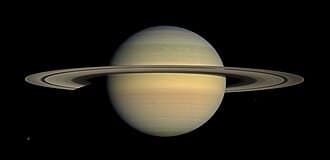
Saturn is the sixth planet from the Sun and the second largest in the Solar System, after Jupiter. It is a gas giant, with an average radius of about 9 times that of Earth. It has an eighth of the average density of Earth, but is over 95 times more massive. Even though Saturn is almost as big as Jupiter, Saturn has less than a third of its mass. Saturn orbits the Sun at a distance of 9.59 AU (1,434 million km), with an orbital period of 29.45 years. Saturn's interior is thought to be composed of a rocky core, surrounded by a deep layer of metallic hydrogen, an intermediate layer of liquid hydrogen and liquid helium, and an outer layer of gas. Saturn has a pale yellow hue, due to ammonia crystals in its upper atmosphere. An electrical current in the metallic hydrogen layer is thought to give rise to Saturn's planetary magnetic field, which is weaker than Earth's, but has a magnetic moment 580 times that of Earth because of Saturn's greater size. Saturn's magnetic field strength is about a twentieth that of Jupiter. The outer atmosphere is generally bland and lacking in contrast, although long-lived features can appear.
Categories
All Wikipedia articles written in American EnglishArticles containing Ancient Greek (to 1453)-language textArticles containing Arabic-language textArticles containing Chinese-language textArticles containing Greek-language textArticles containing Hebrew-language textArticles with hAudio microformatsArticles with short description
Quick Facts
Aphelion
1,514.50 million km (10.1238 AU)
Adjectives
Saturnian /səˈtɜːrniən/,[2] Cronian[3] / Kronian[4] /ˈkroʊniən/[5]
Perihelion
1,352.55 million km (9.0412 AU)
Named after
Saturn
Pronunciation
/ˈsætərn/ ⓘ[1]