百科词条From Wikipedia
Moon
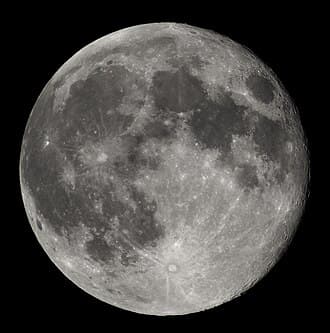
The Moon is the only natural satellite of Earth. It orbits around Earth at an average distance of 384,399 kilometres (238,854 mi), a distance roughly 30 times the width of Earth. It completes an orbit (lunar month) in relation to Earth and the Sun (synodically) every 29.5 days. The Moon and Earth are bound by gravitational attraction, which is stronger on the sides facing each other. The resulting tidal forces are the main driver of Earth's tides, and have pulled the Moon to always face Earth with the same near side. This tidal locking effectively synchronizes the Moon's rotation period (lunar day) to its orbital period (lunar month). In geophysical terms, the Moon is a planetary-mass object or satellite planet. Its mass is 1.2% that of the Earth, and its diameter is 3,474 km (2,159 mi), roughly one-quarter of Earth's (about as wide as the contiguous United States). Within the Solar System, it is larger and more massive than any known dwarf planet, and the fifth-largest and fifth-most massive moon, as well as the largest and most massive in relation to its parent planet. Its surface gravity is about one-sixth of Earth's, about half that of Mars, and the second-highest among all moons in the Solar System after Jupiter's moon Io.
Categories
All Wikipedia articles written in American EnglishArticles containing Ancient Greek (to 1453)-language textArticles containing Arabic-language textArticles containing Chinese-language textArticles containing German-language textArticles containing Latin-language textArticles containing Old English (ca. 450-1100)-language textArticles containing Proto-Indo-European-language text
Quick Facts
Apogee
405400 km(404000–406700 km)
Symbol
or
Perigee
362600 km(356400–370400 km)
Semi-major axis
384399 km  (1.28 ls; 1/389 AU; 1 LD)[1]