百科词条From Wikipedia
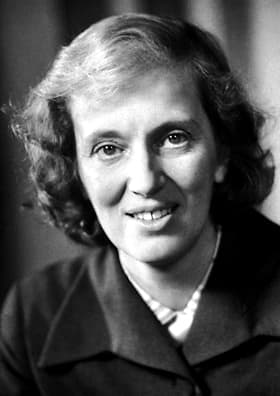
Dorothy Hodgkin
Dorothy Mary Crowfoot Hodgkin (née Crowfoot; 12 May 1910 – 29 July 1994) was an English chemist who advanced the technique of X-ray crystallography to determine the structure of biomolecules, which became essential for structural biology. She received the 1964 Nobel Prize in Chemistry, and is the only British woman scientist to have been awarded a Nobel Prize. Among her most influential discoveries are the confirmation of the structure of penicillin as previously surmised by Edward Abraham and Ernst Boris Chain; and mapping the structure of vitamin B12, for which in 1964 she became the third woman to win the Nobel Prize in Chemistry. Hodgkin also elucidated the structure of insulin in 1969 after 35 years of work. Hodgkin used the name "Dorothy Crowfoot" until twelve years after marrying Thomas Lionel Hodgkin, when she began using "Dorothy Crowfoot Hodgkin". Hodgkin is referred to as "Dorothy Hodgkin" by the Royal Society (when referring to its sponsorship of the Dorothy Hodgkin fellowship), and by Somerville College. The National Archives of the United Kingdom refer to her as "Dorothy Mary Crowfoot Hodgkin".
Categories
1910 births1994 deaths20th-century American women scientists20th-century British women biologists20th-century English biologists20th-century English chemists20th-century English physicists20th-century English women physicists
Quick Facts
Born
Dorothy Mary Crowfoot(1910-05-12)12 May 1910Cairo, Egypt
Died
29 July 1994(1994-07-29) (aged 84)Ilmington, Warwickshire, England
Awards
Royal Medal (1956)
Nobel Prize in Chemistry (1964)
Order of Merit (1965)
Copley Medal (1976)
Dalton Medal (1981)
Lomonosov Gold Medal (1982)
Children
3
Parent(s)
John Winter CrowfootGrace Mary Hood
Known for
Development of protein crystallography
Determining the structure of insulin