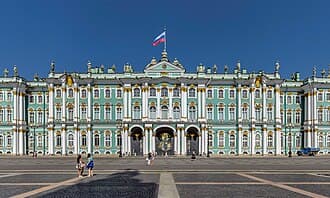
Saint Petersburg
Saint Petersburg, formerly known as Petrograd (Петроград) and later Leningrad (Ленинград), is the second-largest city in Russia, after Moscow, the nation's capital. It is situated on the River Neva, at the head of the Gulf of Finland on the Baltic Sea. With an area of 1,439 square kilometers (556 square miles), Saint Petersburg is the smallest administrative division of Russia by area. The city had a population of 5,601,911 residents as of 2021, with more than 6.4 million people living in the metropolitan area. Saint Petersburg is the fourth-most populous city in Europe, the most populous city on the Baltic Sea, and the world's northernmost city of more than 1 million residents. As the former capital of the Russian Empire, and a historically strategic port, it is governed as a federal city. The city was founded by Tsar Peter the Great on 27 May 1703 on the site of a captured Swedish fortress, and was named after the apostle Saint Peter. In Russia, Saint Petersburg is historically and culturally associated with the birth of the Russian Empire and Russia's entry into modern history as a European great power. It served as a capital of the Tsardom of Russia, and the subsequent Russian Empire, from 1712 to 1918 (being replaced by Moscow for a short period between 1728 and 1730). After the October Revolution in 1917, the Bolsheviks moved their government to Moscow.