百科词条From Wikipedia
Jupiter
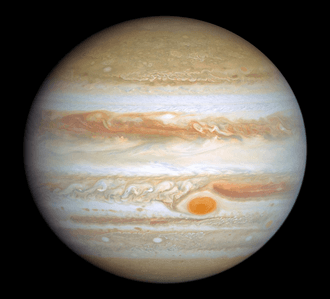
Jupiter is the fifth planet from the Sun, and the largest in the Solar System. It is a gas giant with a mass nearly 2.5 times that of all the other planets in the Solar System combined and slightly less than one-thousandth the mass of the Sun. Its diameter is 11 times that of Earth and a tenth that of the Sun. Jupiter orbits the Sun at a distance of 5.20 AU (778.5 Gm), with an orbital period of 11.86 years. It is the third-brightest natural object in the Earth's night sky, after the Moon and Venus, and has been observed since prehistoric times. Its name derives from that of Jupiter, the chief deity of ancient Roman religion. Jupiter was the first of the Sun's planets to form, and its inward migration during the primordial phase of the Solar System affected much of the formation history of the other planets. Jupiter's atmosphere consists of 76% hydrogen and 24% helium by mass, with a denser interior. It contains traces of the elements carbon, oxygen, sulfur, neon, and compounds such as ammonia, water vapour, phosphine, hydrogen sulfide, and hydrocarbons. Jupiter's helium abundance is 80% of the Sun's, similar to Saturn's composition.
Categories
All Wikipedia articles written in British English with Oxford spellingAll articles containing potentially dated statementsAll articles with dead external linksArticles containing Ancient Greek (to 1453)-language textArticles containing Chinese-language textArticles containing potentially dated statements from 2015Articles containing potentially dated statements from 2025Articles containing video clips
Quick Facts
Aphelion
5.4570 AU (816.363 million km)
Adjectives
Jovian (/ˈdʒoʊviən/)
Perihelion
4.9506 AU (740.595 million km)
Named after
Jupiter
Pronunciation
/ˈdʒuːpɪtər/ ⓘ[2]