百科词条From Wikipedia
North Sea
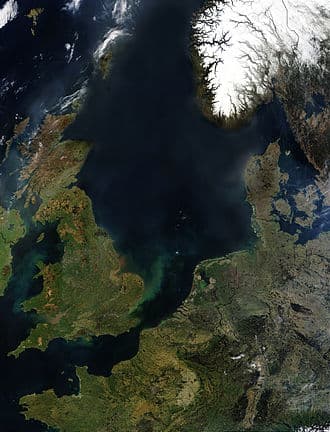
The North Sea lies between Great Britain, Denmark, Norway, Germany, the Netherlands, Belgium, and France. A sea on the European continental shelf, it connects to the Atlantic Ocean through the English Channel in the south and the Norwegian Sea in the north. It is more than 970 kilometres (600 mi) long and 580 kilometres (360 mi) wide, covering 570,000 square kilometres (220,000 sq mi). It hosts key north European shipping lanes and is a major fishery. The coast is a popular destination for recreation and tourism in bordering countries, and a rich source of energy resources, including wind and wave power. The North Sea has featured prominently in geopolitical and military affairs, particularly in Northern Europe, from the Middle Ages to the modern era. It was also important globally through the power northern Europeans projected worldwide during much of the Middle Ages and into the modern era. The North Sea was the centre of the Vikings' rise. The Hanseatic League, the Dutch Republic, and Britain all sought to gain command of the North Sea and access to the world's markets and resources. As Germany's only outlet to the ocean, the North Sea was strategically important through both world wars.
Categories
All Wikipedia articles written in British EnglishAll articles containing potentially dated statementsAll articles with dead external linksArticles containing Bokmål-language textArticles containing Danish-language textArticles containing Dutch-language textArticles containing Dutch Low Saxon-language textArticles containing French-language text
Quick Facts
Type
Sea
Location
Western Europe and Northern Europe
Max. width
580 km (360 mi)
Max. length
960 km (600 mi)
Primary inflows
Baltic Sea, Elbe, Weser, Ems, Rhine/Waal, Meuse, Scheldt, Spey, Don, Dee, Tay, Forth, Tyne, Wear, Tees, Humber, Thames