百科词条From Wikipedia
Whale shark
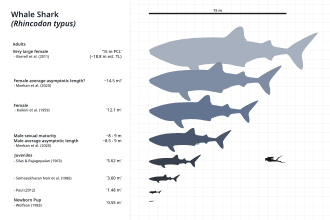
The whale shark (Rhincodon typus) is a slow-moving, filter-feeding carpet shark and the largest known extant fish species. An individual with a length of 18.8 m (61.7 ft) has been considered the largest reliably recorded. The whale shark holds many records for size in the animal kingdom, most notably being by far the most massive living non-cetacean animal. It is the only living species of the genus Rhincodon and the only extant member of the family Rhincodontidae, which belongs to the subclass Elasmobranchii in the class Chondrichthyes. Before 1984, it was classified as Rhiniodon into Rhinodontidae. An extinct species, Rhincodon ferriolensis, was described in Europe (probably in Spain), in the Late Burdigalian stage. The whale shark is an active filter feeder, primarily consuming plankton, krill, fish eggs, and small schooling fish such as sardines and anchovies. The shark can process over 6,000 liters of water per hour through its specialized sieve-like gill pads. Highly migratory, the whale shark travels thousands of miles across tropical oceans to exploit seasonal food sources, with large, predictable feeding aggregations occurring at coastal sites such as Ningaloo Reef in Western Australia, the Yucatan Peninsula in Mexico, and off the coast of Gujarat and Kerala in India. Despite its immense size, the whale shark is docile and poses no significant threat to humans.
Categories
All Wikipedia articles in need of updatingArticles containing Filipino-language textArticles containing Indonesian-language textArticles containing Malagasy-language textArticles containing Vietnamese-language textArticles containing video clipsArticles with 'species' microformatsArticles with short description