百科词条From Wikipedia
Dutch guilder
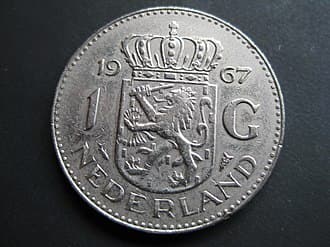
The guilder (Dutch: gulden, pronounced [ˈɣʏldə(n)] ) or florin was the currency of the Netherlands from 1434 until 2002, when it was replaced by the euro. The Dutch name gulden was a Middle Dutch adjective meaning 'golden', and reflects the fact that, when first introduced in 1434, its value was about equal to (i.e., it was on par with) the Italian gold florin. The Dutch guilder was a de facto reserve currency in Europe in the 17th and 18th centuries. Between 1999 and 2002, the guilder was officially a "national subunit" of the euro. However, physical payments could only be made in guilders, as no euro coins or banknotes were available. The exact exchange rate, still relevant for old contracts and for exchange of the old currency for euros at the central bank, is exactly 2.20371 Dutch guilders for 1 euro. Inverted, this gives approximately 0.453780 euros for 1 guilder. Derived from the Dutch guilder were the Netherlands Antillean guilder (Used by Curaçao and Sint Maarten until 2025, replaced by the Caribbean guilder) and the Surinamese guilder (replaced in 2004 by the Surinamese dollar).
Categories
1832 establishments in the Netherlands2001 disestablishments in the NetherlandsAll articles lacking reliable referencesAll articles with unsourced statementsArticles containing Dutch-language textArticles containing French-language textArticles containing German-language textArticles containing Latin-language text
Quick Facts
GB名称
荷兰盾[1] (简体中文)
ISO代码
NLG
使用地
 荷蘭 (至2002年) 蘇里南 (至1962年) 荷属安的列斯 (至1940年)  盧森堡 (至1839年)  比利时 (至1832年)
废止时间
2002年(停止發行)2007年1月1日(硬幣停止流通)2032年1月1日(紙鈔停止流通)